
Can Police Search Your Vehicle Without a Warrant in Ohio?
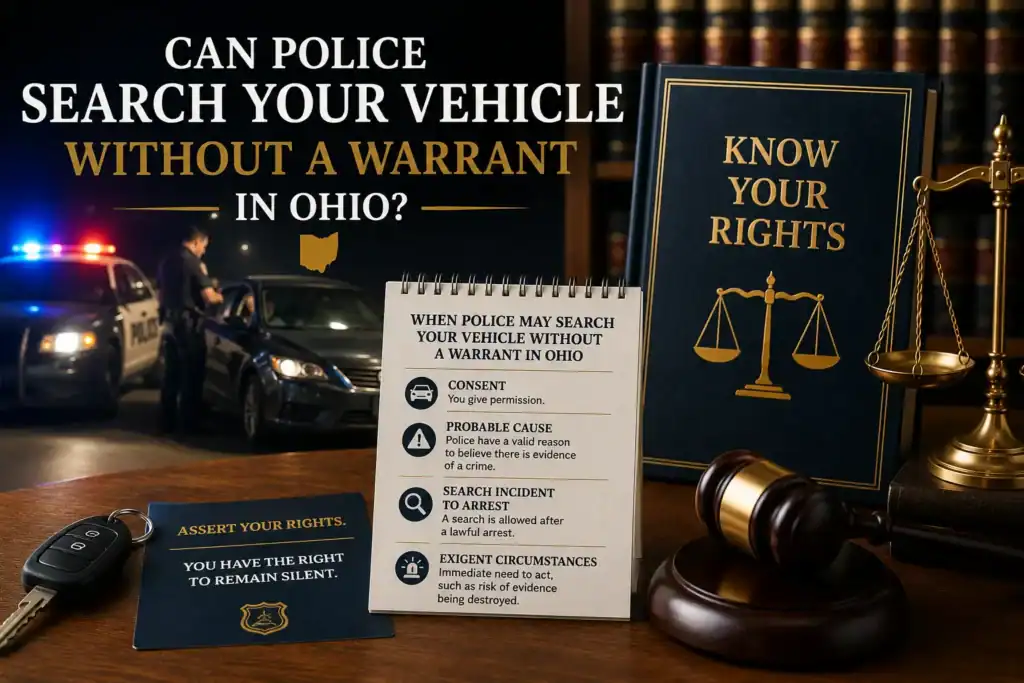
Many Ohio drivers are surprised to learn that police do not always need a warrant to search a vehicle. The Fourth Amendment protects people from unreasonable searches and seizures, but vehicle searches are treated differently than searches of homes. Because cars are mobile and often used on public roads, courts recognize several exceptions that may allow a warrantless search.
That does not mean every vehicle search is legal. In Ohio criminal defense cases, the details matter. The reason for the traffic stop, what the officer saw, what the driver said, whether consent was given, and whether an arrest occurred can all affect whether evidence may be used in court.
Below is a practical overview of common situations where police may search a vehicle without a warrant in Ohio.
The General Rule: Searches Usually Need a Legal Basis
Police generally need a lawful reason to stop a vehicle before a search issue even begins. A stop may be based on a traffic violation, equipment issue, suspected criminal activity, or another lawful basis.
Once a vehicle is stopped, officers cannot automatically search it just because they pulled the driver over. They need a valid legal basis. In many Ohio cases, that basis comes from an exception to the warrant requirement.
Common exceptions include:
- Consent
- Probable cause
- Search incident to arrest
- Plain view
- Inventory searches
- Safety-related searches
Each exception has limits. Whether a search was lawful depends on the specific facts.
Consent Searches
One of the most common ways police search vehicles is by asking for permission. If a driver or someone with authority over the vehicle gives voluntary consent, police may be able to search without a warrant.
Consent can become a major issue in criminal defense cases. Courts may look at whether the person clearly agreed, whether the consent was voluntary, whether the officer exceeded the scope of consent, and whether the person had authority to allow the search.
For example, if an officer asks to “look in the car,” questions may arise about whether that allowed a search of the trunk, locked containers, bags, or other areas. The exact words used by the officer and driver may matter.
Probable Cause and the Automobile Exception
Police may search a vehicle without a warrant if they have probable cause to believe it contains evidence of a crime. This is often called the automobile exception.
Probable cause means more than a hunch. It requires facts that would lead a reasonable officer to believe evidence or contraband may be found in the vehicle.
Examples that may raise probable cause questions include:
- The odor of marijuana or alcohol
- Visible drugs, weapons, or stolen property
- Statements by occupants
- Drug dog alerts
- Evidence connected to a recent crime
- Open containers or suspected contraband
The scope of the search may depend on what officers are looking for. For example, if police have probable cause to believe a large stolen item is in the vehicle, that may not justify searching a tiny container where the item could not fit. If they are searching for drugs, smaller containers may be treated differently.
Search Incident to Arrest
Police may sometimes search a vehicle after arresting an occupant, but this rule has limits. A search incident to arrest is not automatic in every traffic arrest.
In general, the legality may depend on whether the person arrested could access the vehicle at the time of the search or whether it is reasonable to believe the vehicle contains evidence related to the offense of arrest.
For example, an arrest for a drug-related offense may raise different search issues than an arrest for an unrelated traffic warrant. Ohio courts will look closely at the facts, including where the person was located, whether they were secured, and what offense led to the arrest.
Plain View
Police may seize items that are in plain view if the officer is lawfully in a place where they can see the item and it is immediately apparent that the item is evidence, contraband, or connected to a crime.
For example, if an officer lawfully stops a car and sees illegal drugs on the passenger seat, the officer may not need a warrant to seize them. Plain view may also support further search activity if it creates probable cause.
However, plain view does not allow officers to move items around or search hidden areas unless another legal basis applies. The item must be visible from a lawful vantage point.
Inventory Searches
An inventory search may happen when police lawfully impound a vehicle. The purpose is usually to document the vehicle’s contents, protect the owner’s property, protect police from claims of missing items, and identify dangerous items.
Inventory searches are different from evidence searches. They must usually follow standardized police procedures and cannot be used as a pretext for an improper investigative search.
Inventory searches may occur after:
- A vehicle is towed following an arrest
- A vehicle is involved in certain traffic or criminal situations
- A driver cannot legally continue driving
- The vehicle creates a safety or traffic concern
If police claim an inventory search, defense attorneys often review whether the impoundment was lawful and whether officers followed proper policy.
Safety-Related Searches
In some situations, officers may take limited safety measures during a traffic stop. If an officer has a reasonable belief that a person may be dangerous and may access a weapon, the officer may conduct a limited search for weapons in areas within reach.
This type of search is not supposed to be a full evidence search. It is usually limited to officer safety. Whether it was proper depends on what the officer knew at the time and whether the search stayed within legal boundaries.
Passengers, Containers, and Personal Items
Vehicle searches can become more complicated when passengers are involved. Police may search certain areas of a vehicle if a valid exception applies, but questions may arise about purses, backpacks, luggage, locked containers, or items belonging to passengers.
The answer often depends on the reason for the search, where the item was located, who owned it, whether probable cause applied to the container, and whether consent was given. These details can be important if evidence is found inside a personal item.
What Happens If a Vehicle Search Was Illegal?
If police conduct an unlawful vehicle search, a criminal defense attorney may file a motion to suppress evidence. A motion to suppress asks the court to exclude evidence obtained in violation of constitutional rights.
If the court grants the motion, the prosecutor may be unable to use that evidence. In some cases, this can affect plea negotiations, reduce charges, or lead to dismissal. In other cases, the prosecution may still have other evidence and continue forward.
Important evidence in vehicle search challenges may include:
- Dash camera footage
- Body camera footage
- Police reports
- Dispatch records
- Witness statements
- Tow records
- Inventory forms
- Drug dog records
- Officer testimony
Because these cases are fact-specific, a detailed review of the stop and search is often necessary.
When to Contact an Ohio Criminal Defense Attorney
If evidence was found during a vehicle search in Ohio, it is important to understand why the search happened and whether police followed the law. A traffic stop involving drugs, weapons, stolen property, alcohol, or other evidence can quickly become a serious criminal case.
Yonas & Phillabaum, LLC Attorneys at Law assists Ohio consumers and drivers with criminal defense matters, including cases involving traffic stops, vehicle searches, and motions to suppress. Legal guidance can help you understand the facts, the charges, and the options available in your case.
General informational note: This article provides general information about vehicle searches in Ohio and is not legal advice for any specific situation.