What Assets are Exempt From Probate? A Guide for Ohio Families
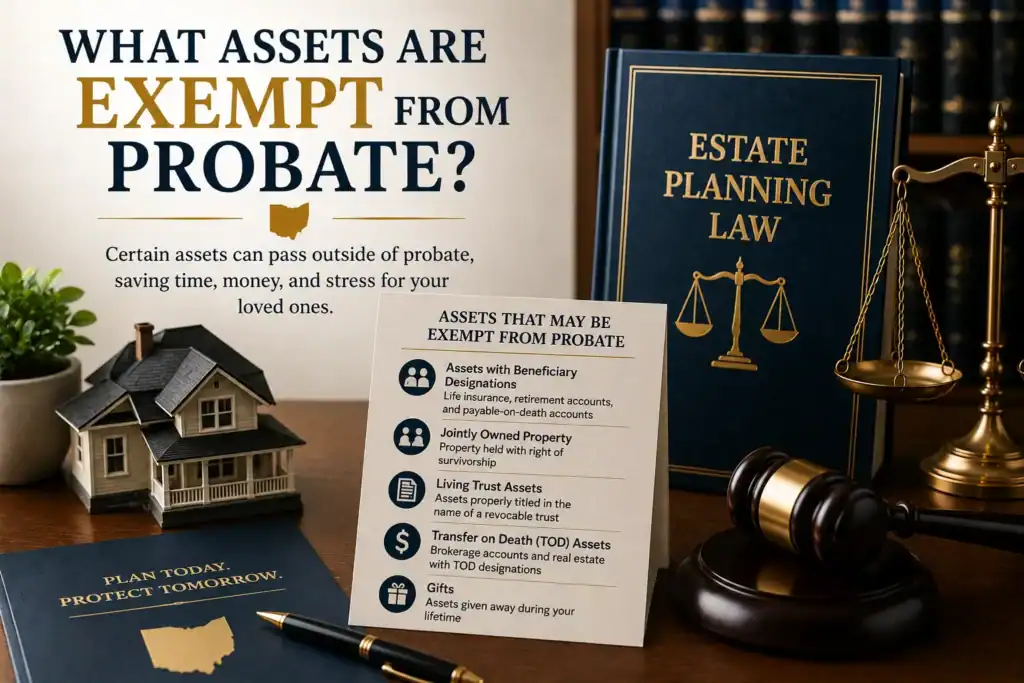
When a loved one passes away, families often expect a long, complicated legal process before they can access what was left behind. The good news? Not every asset has to go through probate. In fact, many of the most valuable things people own can transfer directly to the people they care about, often within days or weeks.
Understanding which assets skip probate can save your family time, money, and stress. Here’s what Ohio consumers should know.
What Is Probate, Exactly?
Probate is the court-supervised process of settling a person’s estate after they die. During probate, the court validates the will, pays outstanding debts and taxes, and oversees the distribution of remaining assets to heirs.
In Ohio, probate can take several months to more than a year, depending on the size and complexity of the estate. It can also be public and costly. That’s why many people plan their estates to keep certain assets out of the process entirely.
Why Are Some Assets Exempt?
Assets typically avoid probate when there’s already a clear, legal path for them to pass to someone else. If an asset has a named beneficiary, a joint owner, or sits inside a trust, the court usually doesn’t need to get involved. Ownership simply transfers based on the terms already in place.
So, the key question isn’t just what you own. It’s how you own it.
Assets That Commonly Pass Outside Probate in Ohio
Here are the most common types of assets that often bypass probate.
Jointly Owned Property With Survivorship Rights
When two people own property as “joint tenants with rights of survivorship,” the surviving owner automatically inherits the deceased person’s share. This often applies to real estate, bank accounts, and other titled property. The asset never enters probate because ownership shifts the moment one owner passes away.
Payable-on-Death and Transfer-on-Death Accounts
Many Ohio residents use payable-on-death (POD) and transfer-on-death (TOD) designations. These let you name a beneficiary who receives the asset directly when you die.
- POD typically applies to bank accounts and CDs.
- TOD often applies to investment accounts and, in Ohio, even real estate through a transfer-on-death designation affidavit.
These tools are popular because they’re simple to set up and keep assets moving smoothly.
Life Insurance Proceeds
Life insurance payouts go directly to the named beneficiary, skipping probate altogether. This is one reason life insurance is a cornerstone of many estate plans. Just keep in mind: if the policy names your estate as the beneficiary, the funds may end up in probate after all.
Retirement Accounts With Named Beneficiaries
Accounts like 401(k)s and IRAs pass to whoever you’ve designated. As long as a valid beneficiary is on file, these funds transfer directly. This is why reviewing your designations after major life events matters so much.
Trust Assets
Assets held in a properly funded living trust avoid probate because the trust, not you personally, owns them. The trustee distributes those assets according to your instructions without court involvement. Trusts also offer added privacy, since they aren’t part of the public probate record.
Certain Vehicles and Simplified Transfers
Ohio allows surviving spouses to transfer up to two motor vehicles (within certain value limits) without formal probate. The state also offers simplified procedures for smaller estates, which can speed things up for many families.
Why You Should Still Review Your Plan
Here’s a common mistake: setting up beneficiary designations once and never looking at them again. Life changes. People marry, divorce, have children, or lose loved ones. An outdated beneficiary form can send your assets to the wrong person, no matter what your will says.
A few smart habits go a long way:
- Review beneficiary designations after major life events.
- Confirm how each major asset is titled.
- Make sure your trust is actually funded, not just created.
- Coordinate your beneficiary forms with your overall estate plan.
Even small inconsistencies can create confusion or conflict for your family later.
The Takeaway
Many valuable assets, including joint property, POD and TOD accounts, life insurance, retirement funds, and trust holdings, can pass to your loved ones without going through probate. Structuring ownership and beneficiary designations correctly is one of the simplest ways to protect your family’s time and resources.
Every situation is different, and outcomes depend on your individual circumstances and current Ohio law. This article is for general information only and isn’t legal advice. To make sure your plan reflects your wishes, talk with a qualified estate planning attorney.
If you’d like guidance tailored to your family, the team at Yonas & Phillabaum is here to help you plan with confidence.