
Expungement vs. Record Sealing in Ohio
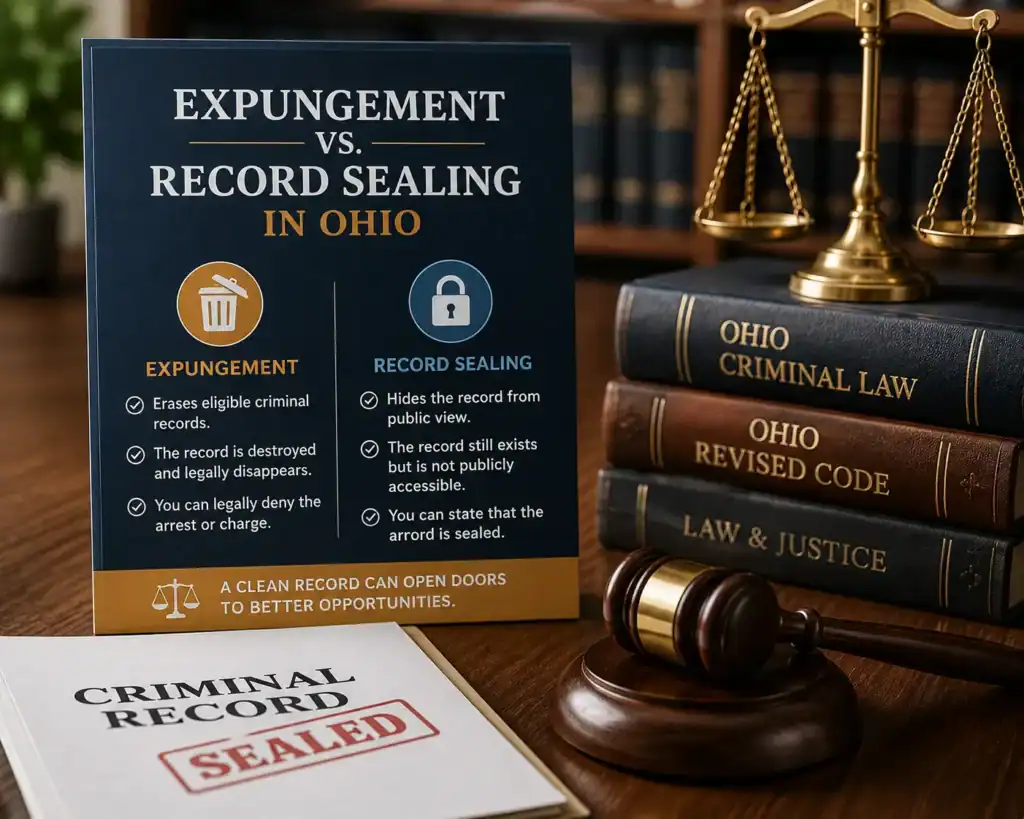
A criminal record can follow you long after a case ends. It may appear during background checks for jobs, housing, professional licenses, loans, volunteer work, or education programs. Even a dismissed charge can raise questions if it remains visible in public court records.
Ohio offers forms of criminal record relief that may help eligible people move forward. Two common terms are record sealing and expungement. People often use these words interchangeably, but in Ohio they can mean different things. Understanding the difference can help you decide whether to explore your options.
What Is Record Sealing in Ohio?
Record sealing means the public record is hidden from most public background checks. The case does not simply disappear, but access becomes limited.
When a record is sealed, most employers, landlords, and members of the public should not be able to see it through ordinary court record searches. This can make a major difference when applying for work, housing, or other opportunities.
However, sealed records may still be available to certain government agencies, courts, law enforcement, licensing boards, or employers in specific fields. For example, jobs involving children, older adults, law enforcement, education, healthcare, or financial trust may involve more detailed background checks.
In practical terms, sealing a record can help reduce the day-to-day impact of a criminal case, but it does not erase the fact that the case once existed for every possible purpose.
What Is Expungement in Ohio?
Expungement is often understood as a stronger form of record relief. In Ohio, expungement generally refers to the destruction, deletion, or permanent removal of certain records, depending on the type of record and the law that applies.
For many people, expungement sounds like the ideal result. But not every case qualifies for expungement, and the exact effect can depend on the record involved. Ohio law has changed in recent years, so it is important not to rely on old information or assume that what applied to someone else will apply to your case.
The key point is this: sealing limits public access, while expungement may go further by removing or destroying eligible records. Both can be valuable, but they are not automatic.
Who May Benefit From Record Sealing or Expungement?
Ohio criminal record relief may help people who are trying to move forward after an arrest,
charge, or conviction. You may benefit if your record affects:
- Job applications
- Apartment or housing applications
- College or trade school applications
- Professional licensing
- Security clearance concerns
- Volunteer opportunities
- Business opportunities
- Loan or financing applications
- Personal peace of mind
A sealed or expunged record can help reduce barriers, especially when the record is old,the person has completed all sentencing requirements, and there have been no new legal problems.
Record relief may also help people with dismissed charges or not guilty findings. Many people are surprised to learn that even if they were never convicted, the arrest or court case may still appear in public records unless action is taken.
Eligibility Depends on the Case
One of the most important things to understand is that eligibility for sealing or expungement depends on the details of the case. There is no single rule that covers every Ohio criminal record.
Eligibility may depend on:
- Whether the case ended in conviction, dismissal, acquittal, or no bill
- The level of offense, such as misdemeanor or felony
- The type of offense
- The number of convictions on the person’s record
- Whether there are pending criminal charges
- Whether all fines, costs, restitution, probation, or jail terms are complete
- How much time has passed since the case ended
- Whether the offense is excluded under Ohio law
- Whether the prosecutor objects
- Whether the court finds that sealing or expungement is appropriate
This is why two people with similar records may receive different results. A first-degree misdemeanor may be treated differently from a felony. A dismissed charge may be treated differently from a conviction. A traffic-related offense may be handled differently from a criminal offense. A case involving a victim, violence, sex offense, or public office may raise special issues.
Not Every Conviction or Charge Qualifies
People should be careful not to assume that every Ohio conviction or charge can be sealed or expunged. Some records may be excluded by law. Others may require a waiting period. Some may be eligible for sealing but not expungement. Others may be eligible only after certain conditions are met.
Common reasons a person may not qualify include:
- The offense is not eligible under Ohio law
- Too little time has passed
- The person has pending charges
- Court-ordered requirements are not complete
- The person has too many convictions for the type of relief requested
- The record involves an offense with special restrictions
- The prosecutor or victim objects and the court denies the request
A denial does not always mean relief will never be possible. In some cases, a person may need to wait longer, resolve unpaid obligations, complete a sentence, or apply under a different form of record relief.
Why Recent Ohio Law Changes Matter
Ohio’s record sealing and expungement laws have changed in recent years. These changes have expanded relief for some people, changed waiting periods in some situations, and created new questions about how certain records are treated.
That is good news for many Ohioans. Someone who did not qualify years ago may qualify now. At the same time, the law remains detailed. The answer still depends on the case, the offense, the person’s full record, and the court’s review.
Because of these changes, relying on old advice, online forums, or a friend’s experience can lead to mistakes. A person may miss an opportunity by assuming they do not qualify, or they may file too early and face an avoidable denial.
What Happens During the Record Relief Process?
The process usually starts with reviewing the person’s complete criminal record. This may include municipal court, county court, common pleas court, mayor’s court, and statewide records.
After eligibility is reviewed, a petition or application may be filed with the appropriate court. The prosecutor may have a chance to object. The court may schedule a hearing, although some matters may be handled without extensive court appearances depending on the case.
At the hearing, the judge may consider the nature of the offense, the applicant’s rehabilitation, objections, public interest, and whether the person meets the legal
requirements.
If the court grants the request, it will issue an order directing the appropriate agencies to seal or expunge the eligible records.
Why Working With an Ohio Attorney Can Help
Record sealing and expungement can be life-changing, but the process is not always simple. Filing the wrong request, filing in the wrong court, misunderstanding eligibility, or overlooking an old case can delay relief.
An Ohio criminal defense attorney can help:
- Review your full record
- Determine whether you may qualify
- Explain the difference between sealing and expungement
- Identify waiting periods and excluded offenses
- Prepare and file the correct paperwork
- Respond to objections
- Represent you at a hearing if needed
Yonas & Phillabaum, LLC Attorneys at Law assists Ohio consumers seeking criminal record relief. If a past charge or conviction is affecting your future, it may be worth finding out whether sealing or expungement is available.
General note: This article provides general information about Ohio record sealing and expungement and is not legal advice for any specific situation.